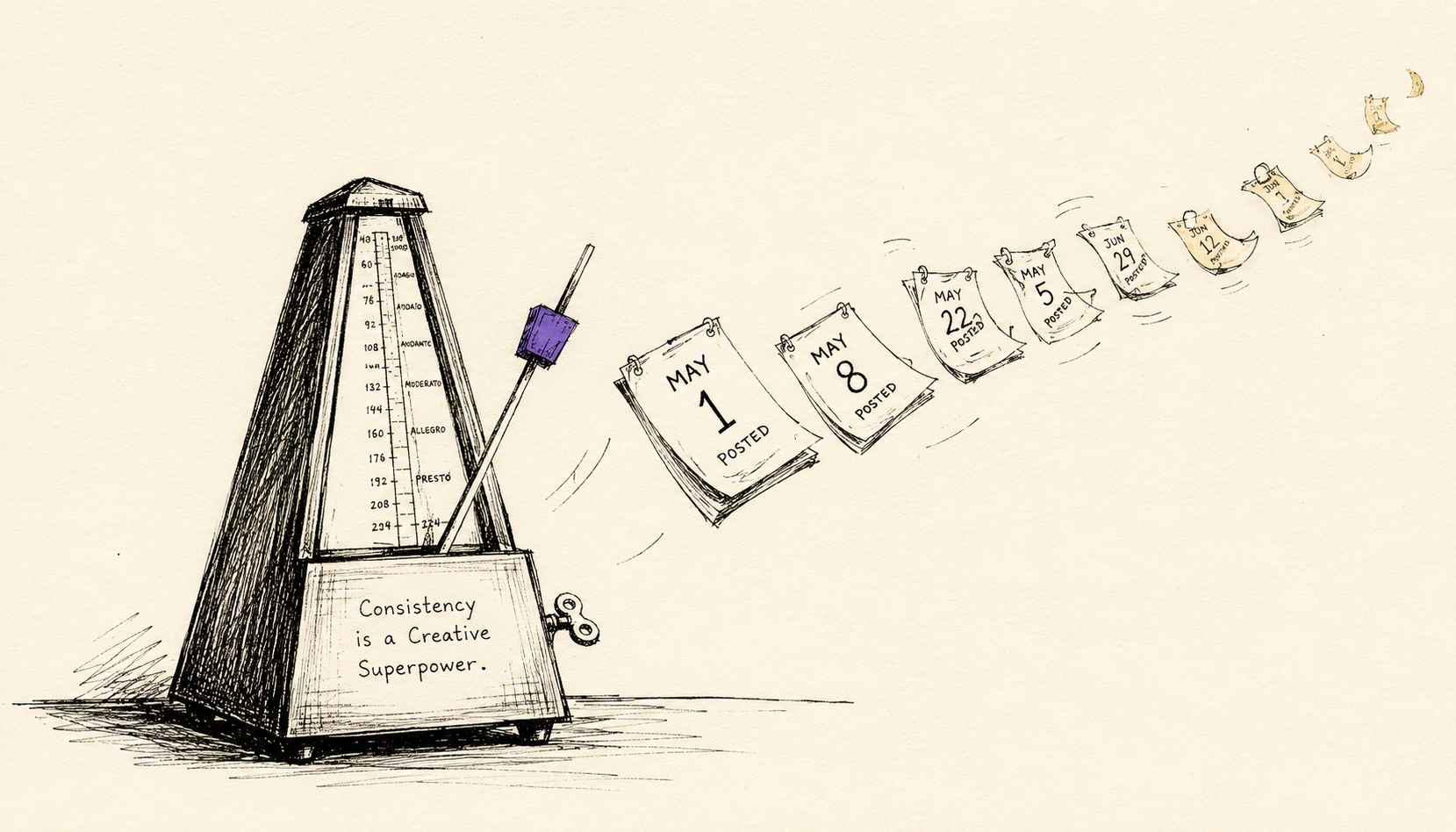
For most service businesses in 2026, the ranking sweet spot is one to two well sourced posts a week, not a daily firehose. Volume helps until about 11 posts a month, then the traffic curve flattens. What actually decides ranking is consistency plus freshness, sustained for months, not a single burst.
The short version: cadence matters, but not the way most owners think. Steady beats sporadic, fresh beats stale, and quality gates everything. A blog that posts once a week for a year outranks one that dumps ten posts in a week and then goes quiet. Below is what the data says, where it gets uncomfortable, and how to pick a cadence you can actually hold.
Daily vs weekly vs monthly: what the data actually rewards
HubSpot's blogging benchmark study found companies publishing 16+ posts a month earned almost 3.5x more inbound traffic than those publishing 0 to 4. For small teams of ten or fewer, around 11 posts a month drove close to 3x the traffic of posting once. More is better, up to a point. The same study now recommends blogs under a year old aim for 6 to 8 posts a month around a few tight topic clusters, not a daily grind.
| Cadence | Ranking momentum | AI freshness signal | Sustainable solo? |
|---|---|---|---|
| Daily (about 30 a month) | High, then flattens | Strongest | Rarely |
| 1 to 2x a week (6 to 8 a month) | High | Strong | Hard but doable |
| Weekly (about 4 a month) | Steady | Moderate | Doable |
| Monthly (1 a month) | Weak | Decays | Easy, low impact |
Inbound traffic by monthly publishing volume
Relative to a 0 to 4 posts per month baseline, HubSpot benchmark
That HubSpot curve is correlation, not proof that volume causes ranking. Big publishers post more because they already have authority and budget, so some of that 3.5x is reverse causation. The honest read is narrower: consistency and freshness move rankings, raw count past 11 a month mostly does not. We will pull a cadence controlled study in a future drop.
Why freshness changed the cadence math in 2026
AI search engines now treat recency as a ranking filter. Content updated within the last 30 days earns roughly 3.2x more ChatGPT citations than older pages, and about 76% of ChatGPT's top cited pages were updated in the last month. A blog that goes quiet does not just stop growing, it starts decaying out of AI answers.
“Content updated three weeks ago is getting cited by ChatGPT at 3.2x the rate of older pieces.”
Perplexity is the most freshness sensitive engine of the three. Roughly half of its citations come from content less than 13 weeks old, and updating a page can shift its Perplexity citations within days. Google's AI Overviews and ChatGPT weight recency too. The practical takeaway: the same engine work that earns a Google ranking also keeps you alive in AI answers, but only if the publishing does not stop.
“Roughly half of all AI-cited content is less than 13 weeks old; content under 30 days earns an estimated 3.2x more AI citations.”
The quality threshold: why a daily firehose backfires
Volume has a ceiling. Multiple 2026 analyses find the traffic per post curve flattens after about 11 posts a month, the point where adding volume stops adding proportional value. Google's March 2026 core update re-weighted Information Gain, a signal for how much genuinely new knowledge a page adds versus what already ranks. Twenty thin posts assembled from the same sources as the top five results do not clear that bar. Eight deeply researched, sourced posts do.
Cadence is not about how many posts you publish. It is about never going quiet long enough for the models to forget you exist.
“Companies that published 16+ blog posts per month got almost 3.5X more traffic than companies that published between 0 to 4 monthly posts.”
How long until cadence pays off
Patience is part of the cadence math. Ahrefs found only 1.74% of new pages reach the top 10 within a year, and the average number one page is about five years old. Of the pages that do break into the top 10, about 41% got there within a month, usually for lower competition terms. Translation: a single post is a lottery ticket, a steady library is an asset that compounds. The posts you publish this quarter mostly pay off in the next two.
“Only 1.74% of newly published pages rank in the top 10 within a year; the average number one ranking page is about 5 years old.”
What that cadence costs to run
Holding a real cadence is where most owners stall. A professional freelance writer charges $250 to $399 for a single sourced 1,500 word post, and six figure writers often charge $1,000+ per piece. Content agency retainers commonly run $2,000 to $3,000 a month for mid size businesses, and full B2B programs $5,000 to $15,000. The bottleneck is rarely one post. It is the fourth post in week six, when the listing rush hits and the blog goes dark.
Cadence Reality Calculator
What a sustained pace would cost in your own time if you ran it yourself.
Those defaults assume you value an hour at 200 dollars and that DIY posts match a pro's quality. Plenty of owners write a sharper post than any vendor because they know the customer cold. The real question is not cost per post, it is whether it ships every week for a year. We will add a consistency odds field next drop.
If you can only commit to one cadence rule, make it this: never let two weeks pass with nothing new. Freshness decay in AI answers starts faster than most rankings drop.
Three questions
- 1.After how many posts a month does the traffic per post curve start to flatten?
- 2.What share of ChatGPT's top cited pages were updated in the last 30 days?
- 3.What matters more for ranking, a single burst of posts or steady cadence?
- For most service businesses, one to two well sourced posts a week, about 6 to 8 a month, is the sweet spot. HubSpot's data shows traffic climbs with volume up to about 11 posts a month, then flattens. Below weekly, momentum and AI freshness both fade. The cadence you can sustain for a year beats a faster pace you abandon in month two.
Here is the honest summary: cadence is a real ranking lever, but it only works if it stays in motion for months, at a quality bar that clears Google's Information Gain test and keeps you fresh in AI answers. That is not hard for a week. It is hard for a year. This blog is the proof of concept: the same engine publishes one sourced, ranked post here every day with no human editing the body, and our Client Zero, Royal Sparkle Creations (Kathy Brown's brand), drew 35,084 views in 28 days, 96.5% from real searches. If holding that cadence yourself is the part that keeps slipping, that is exactly the shape we work in: done for you SEO and GEO posts, plans from $50 a month, with a page one ranking guarantee. If that fits your situation, apply at /service-request.
Discussion (0)